The Holland Report - 2023, Week 12, Sine Die!
 Sara Fuchs
The dust has finally settled, and the legislative session for 2023 has come to an end. The last week of March marked legislative days 39 and 40, both days that went well past sundown as legislators worked to pass bills and - more importantly - come to agreements on changes to bills between the House and the Senate. It was an eventful session marked by new leadership in both chambers, a huge (and diverse) new class of freshman legislators, and a nail-biter waiting to vote on the budget (which finally passed around midnight on the last day of session). For many, this session will be marked by the passing of several worrisome bills, including a new law that restricts how doctors can treat transgender children and a bill that gives expanded oversight of local district attorneys. For me personally, I'll remember this legislative session for two bills that DID NOT pass. The first was the defeat more than a month ago of the City of Buckhead City legislation on the floor of the Senate. The other was the surprise failure of the school voucher bill on Sine Die - a bill where all but one Democrat and a whopping 16 Republicans voted no.
Any bill that passed the General Assembly now goes to Governor Kemp for signature or veto. The governor has already signed some bills into law and exercised his right to veto one, a bill that would have capped tuition increases at the University System of Georgia (legal minds believe it might have been unconstitutional). Kemp's office has forty days from Sine Die to veto any additional legislation. Otherwise, the passed bills will go into effect.
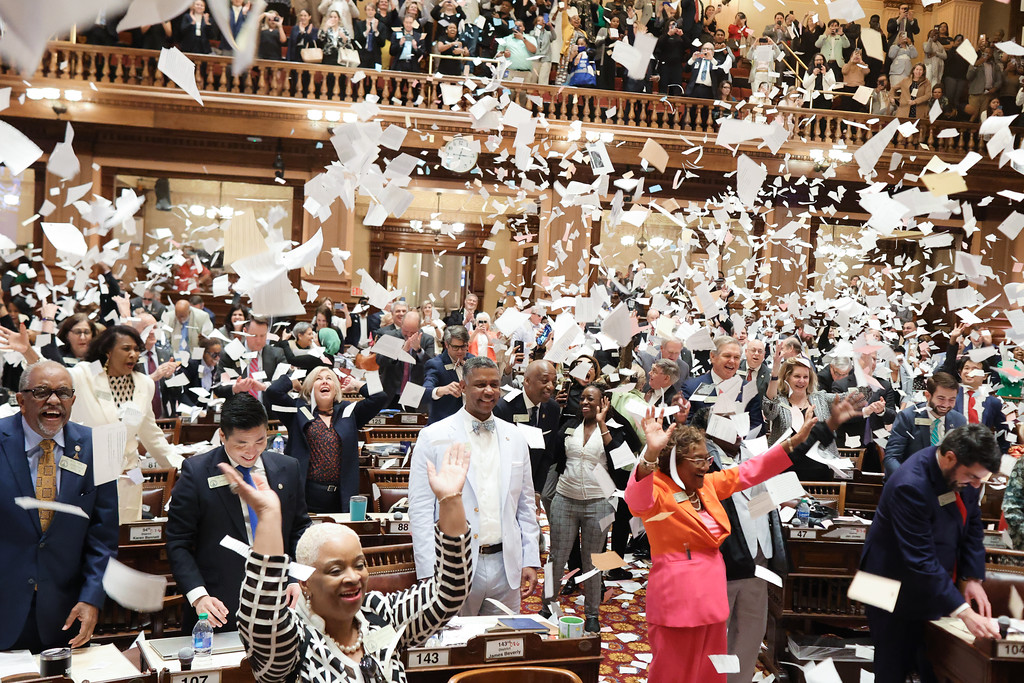
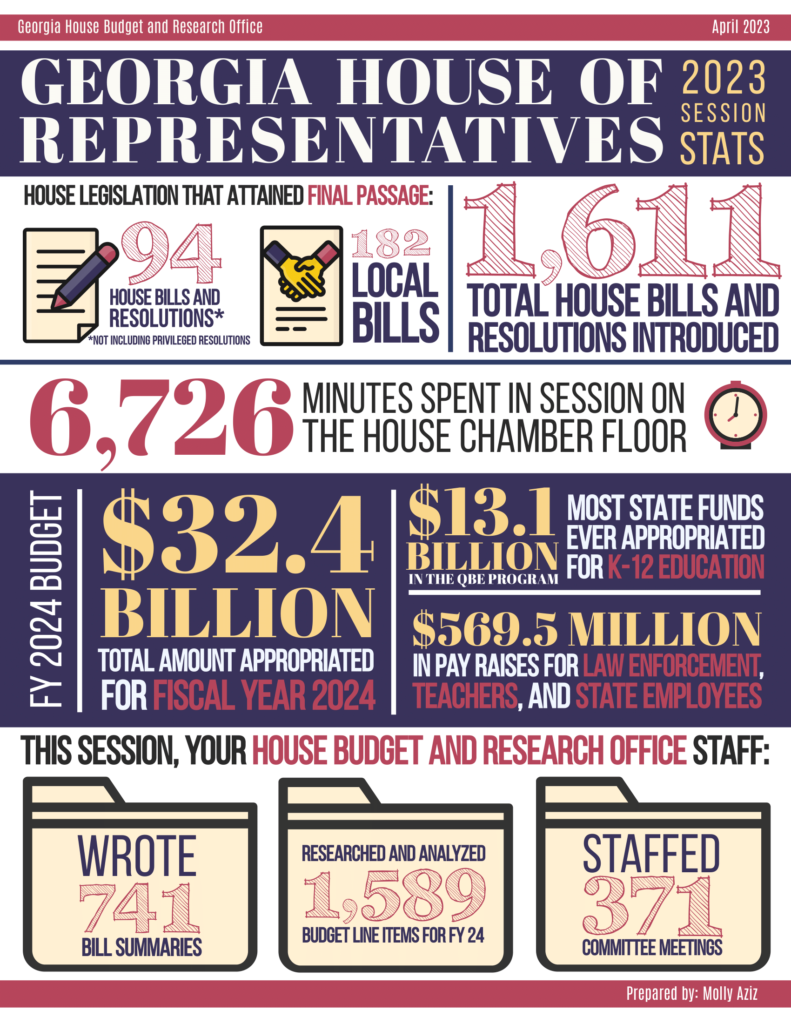
On the 40th day, into the late hours of Sine Die, the House passed the final version of the 2024 budget (HB19). There were several positive steps in the 32.4 billion dollar spending plan as well as several unfortunate cuts. Some of the highlights include:
- The HOPE scholarship is restored at 100 percent.
- 11 million was added to the budget to authorize Department of Family and Children Services (DFCS) to hire up to 450 eligibility caseworkers and promote 75 supervisors to help the state prepare for the Medicaid unwinding. While this is a positive step, it is insufficient for the resources needed from the overworked and underpaid social workers who will now have to potentially process millions of redeterminations in 14 months.
- $27 million was added to help recruit school counselors and fully fund the Quality Basic Education formula.
- The budget also provided $229 million to help school districts pay for a 67 percent increase in the employer contribution of per-person monthly premiums for classified employees.
- The budget cuts $66 million from higher education.
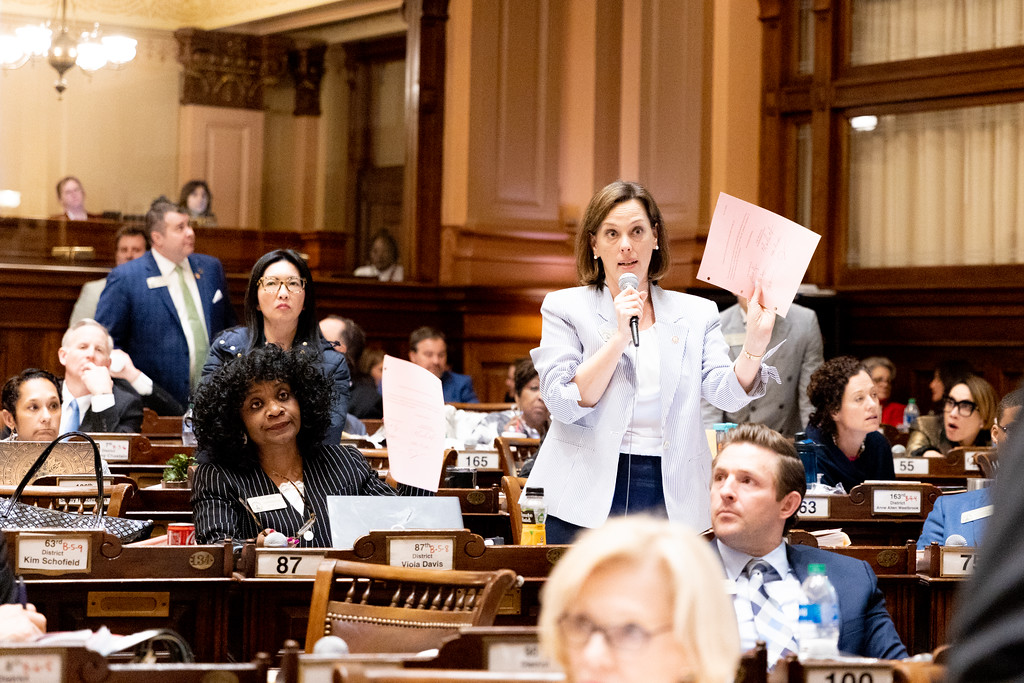
I voted YES on these bills, and they passed both chambers.
HB 538. Georgia Early Literacy Act; enact.
This bill require schools to revamp how they teach reading in kindergarten through third grade, and it would overhaul teacher certification and training, using evidence-based approaches.
SB 211. Georgia Council on Literacy; establish.
This bill helps implements the Georgia Early Literacy Act by establishing a 30-member council of political appointees to review existing literacy programs and determining what is evidence-baed.
HB 340. Education; daily duty-free planning periods for teachers in grades six through twelve; provide.
Teachers will be provided one planning period during their school day.
SB107. "Izzy's Law"; Depart. of Public Health shall develop and make available for download from its internet website a model aquatic safety plan based on national standards for private swim instructors; provide
States the Department of Public Health shall develop and make available for download from its website a model aquatic safety plan based on national standards for private swim instructors.
HB163. Georgia Board of Health Care Workforce; student loan repayment for medical examiners employed by the Division of Forensic Sciences of the Georgia Bureau of Investigation; provide
Provides for student loan repayment for medical examiners employed by the Division of Forensic Sciences of the Georgia Bureau of Investigation.
HB249. Education; needs based financial aid program; provide definition.
Lowers the threshold of courses that must be completed for students before they can qualify for a needs-based financial aid “completion grant” to finish their degree.
HB129. Public assistance; expand temporary assistance for needy families eligibility criteria to pregnant women.
Pregnant women are now eligible for the existing Temporary Assistance for Needy Families program. The program is currently available to families with children, but not expecting parents. To qualify, families have to meet strict income limits and weekly work requirements.
HB155. Professions and businesses; issuance of licenses by endorsement for spouses of firefighters, healthcare providers, and law enforcement officers who relocate to Georgia; provide
Makes it easier for spouses of firefighters, healthcare providers, and law enforcement officers who relocate to the State of Georgia to receive professional licenses.
SB129. Primaries and Elections; time off for employees to advance vote; provide.
Provides time off for employees in Georgia to early vote.
SB86. Education; eligible students participating in the Dual Enrollment program to access HOPE career grant funds for certain CTAE courses; allow.
Allows eligible students participating in the Dual Enrollment program to access HOPE career grant funds for certain CTAE courses irrespective of whether they have reached maximum credit hour caps.
SB246. Georgia Board of Health Care Workforce; student loan repayment for certain nursing faculty; provide
Provides for student loan repayment for certain nursing faculty.
I voted NO on these bills, and they passed both chambers.
SB 92. Prosecuting Attorneys Oversight Commission; create.
This bill creates a five member commission who can investigate, punish, and remove district attorneys and solicitor generals. There are already layers of accountability in the system, and this is a blatant attack on district attorneys representing Democratic areas, such as Fulton county & Athens-Clark county. This is a gross overreach of the power of the General Assembly. There is already a system in place that keeps these attorneys accountable.
SB 222. Primaries and Elections; all costs and expenses relating to election administration are paid for with lawfully appropriate public funds; provide.
SB 222 prohibits county or municipal governments, government employees (including election superintendents, registrars, poll workers), or election officials from soliciting, taking, or otherwise accepting from any person a contribution, donation, service, or anything else of value for the purpose of conducting or supporting primaries or elections. This bill was proposed in response to a $2 million award that Dekalb County received from the Center for Election Excellence, a project of the Center for Tech and Civic Life.
HB 147. Safe Schools Act; enact.
This bill makes annual active shooter drills mandatory in Georgia classrooms, and parents may not opt out. This bill offers only illusory protections in schools, and does not include safety measures that would actually protect our kids, such as universal background checks and red flag gun laws.
SB 44
Street Gang Terrorism and Prevention Act; mandatory minimum penalties for violations; provide
This bill creates a new offense for recruiting minors to gangs and establishes a mandatory minimum sentencing scheme for all gang offenses. Mandatory minimums can tie the hands of judges while experts point out they do not deter criminal activity.
SB 140. Hospitals; the treatment of gender dysphoria in minors performed in hospitals and other licensed healthcare facilities; prohibit certain surgical procedures.
This bill stops hospitals from providing gender-affirming health care procedures or therapies to Georgians younger than 18 years old. These decisions should be made by families and health professionals, not by legislators.
SB62. Counties and Municipal Corporations; certain local ordinances or policies relating to public camping or sleeping; prohibit.
This bill prohibits both hospitals and government authorities from transporting and dropping off homeless individuals outside the jurisdiction, unless the person was previously a resident receiving care from the government of that jurisdiction, or the location for drop-off is a facility or other location that has agreed to accept the unhoused individual. The bill also requires county and municipal governments to enforce prohibitions against public camping, sleeping, or obstruction of sidewalks. Homelessness should not be criminalized. Watch my remarks below.
These bills DID NOT PASS out of the House & Senate this year; however, with a two-year session, we may well see them in 2024.
SB 233. 'The Georgia Promise Scholarship Act'; establishment of promise scholarship accounts.
It's rare that a bill is defeated on the House floor, but more than a dozen mostly rural Republicans joined Democrats to defeat this measure. This bill would have established a $6,500 annual subsidy for students who left a low-performing public school for a private school or for home schooling. School vouchers divert critical educational funding from schools in need.
HB 520. Mental health bill.
This bipartisan mental health bill and a continuation of the late Speaker Ralston's legacy failed to pass the Senate. A small section of the bill, dealing with data sharing between state agencies, was added to another bill and passed.
HB 380. Georgia Lottery Game of Sports Betting Act; enact.
The online sports betting bill, along with several other iterations, failed to gain any traction this year, in either the House or the Senate.
HB 404. Safe at Home Act; enact.
Another bipartisan bill supported by House leadership did not pass out of the Senate. This bill would have provided greater protections for tenants, requiring landlords to provide rental homes fit for human habitation.
Missed my Legislative Wrap-Up with Rep. Saira Draper? Watch it below!
Now that the election's over, I can return to my least favorite activity as your elected representative - asking for money! Session may be over, but the job continues year-round. State legislators receive only $7000 each year to run their offices - the difference is made up with campaign funds. Will you consider becoming a monthly donor?
- $10/month pays for office supplies.
- $15/month pays for our Zoom subscription, an essential service these days, and how I run my Listening Sessions!
- $20/month keeps our website up and running.
Every little bit helps! You can set up a recurring donation here.
If you haven’t already, please browse my website, betsyforgeorgia.com.
As your Representative, your concerns are important to me. Please contact me at betsy.holland@house.ga.gov or 404-656-0116 with questions, concerns, or solutions you may have regarding legislation or other happenings in District 54.
To stay updated, follow me on Twitter and Facebook, and follow the Georgia House of Representatives @GAHouseHub on Twitter. Additionally, in-depth information regarding current bills, Georgia's annual and supplemental budgets, committee meetings, and livestreams from the General Assembly can be accessed via www.legis.ga.gov.
I encourage you and your family to visit our State Capitol and my office, where all constituents are welcome. I look forward to connecting with you!
My office is located at:
18 Capitol Square, SW
409-B, Coverdell Legislative Office Building
Atlanta, Georgia 30334
Thank you for allowing me to serve as your representative.

Representative Betsy Holland
GA House District 54